Writing a config
What this is. The file format: what a pipeline is made of, how a sink picks what it writes, and the one shape the format cannot express. Everything here applies equally to a batch run and to the editor.
A pipeline is source → stages → sinks. Stages are an ordered list applied to
every frame; nothing branches on runtime state, so there is no state machine —
the only "state" is background-warmup vs steady, which BackgroundModel.ready
handles with one if.
name: baseline

source:
  type: video
  path: inputs/gasvid.mp4

stages:
  - {type: gray}
  - {type: median_blur, ksize: 7, name: smoothed}
  - {type: static_mask, threshold: 127}
  - {type: mean_background, n_frames: 60}
  - {type: apply_mask, name: masked}

sinks:
  - {type: ffmpeg, path: outputs/result.mp4}
  - {type: display, input: source}
Every entry is a {type: ..., **params} mapping. type picks the registered
class, the rest are its constructor arguments, and an unknown name raises with
the list of known ones. There is no schema to keep in step: the constructor
is the schema.
The context
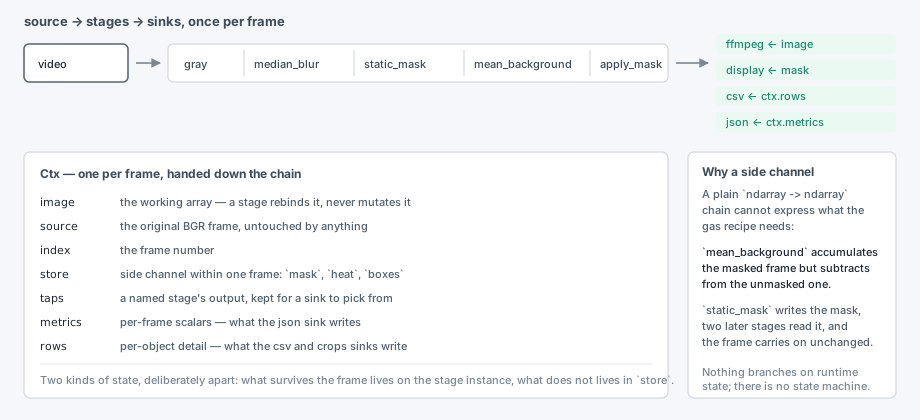
@dataclass
class Ctx:
    image: np.ndarray   # working array; stages rebind it
    source: np.ndarray  # original BGR frame, untouched
    index: int
    store: dict         # side channel within one frame
    taps: dict          # named stages' outputs, for sinks to pick from
    metrics: dict       # per-frame scalars, what the json sink writes
    rows: dict          # per-object detail, what the csv and crops sinks write

class Stage(Protocol):
    def apply(self, ctx: Ctx) -> None: ...

class Sink(Protocol):
    def write(self, ctx: Ctx) -> bool: ...   # False stops the run
    def close(self) -> None: ...
Two kinds of state, deliberately kept apart:
| State | Lives in | Example |
|---|---|---|
| Across frames | the stage instance | StaticMask.mask, MeanBackground._model, Farneback._history |
| Within one frame | ctx.store |
store["mask"] written by static_mask, read by apply_mask |
That side channel is what a plain ndarray -> ndarray chain cannot express: the
mean background model accumulates the masked frame but subtracts from the
unmasked one.
Contract for stages: rebind ctx.image, never mutate the array in place —
image and source alias the same buffer when a frame enters the chain, and no
defensive copy is taken (these videos are large enough that per-frame copies are
pure waste).
Choosing what a sink outputs
Give a stage a name: to tap its output, then point a sink at it with input::
stages:
  - {type: gray}
  - {type: median_blur, ksize: 7, name: smoothed}
  - {type: static_mask, threshold: 127}
  - {type: mean_background, n_frames: 60}
  - {type: apply_mask, name: masked}

sinks:
  - {type: ffmpeg, path: outputs/result.mp4}                 # default: the final image
  - {type: display, input: source}                           # untouched footage
  - {type: display, input: smoothed}                         # mid-chain
  - {type: display, input: mask}                             # the ROI mask artifact
input: resolves in this order — image (the chain's final output, the
default), source, a named stage's tap, then any image-valued entry in
ctx.store. Anything else raises, listing what is available. Display sinks title
their window after input unless given a window:, so several of them coexist
instead of fighting over one window.
Taps are opt-in: an unnamed stage costs nothing, and a duplicated name: is
rejected.
Gotcha: a tap holds
ctx.imageafter the stage ran.static_maskpublishes a mask but leaves the frame alone, soname:on it taps its input image — reach the mask itself withinput: mask.
Branching with select
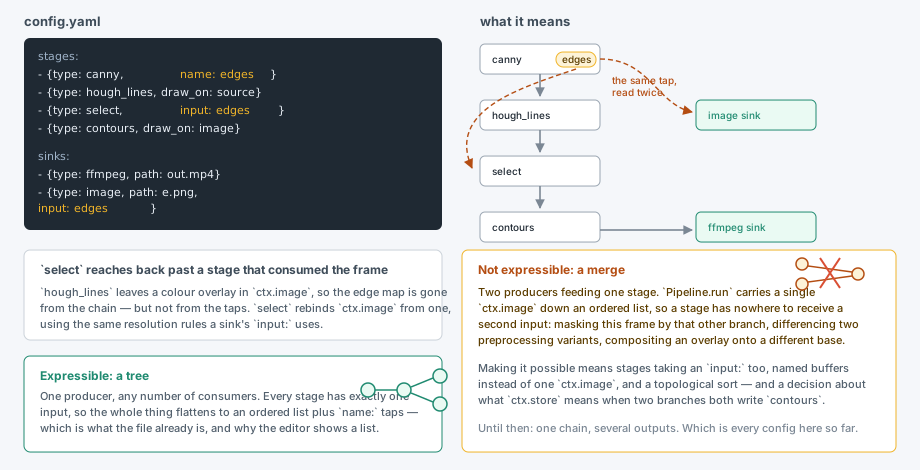
A stage that draws consumes the working frame. select reaches back past it,
using the same resolution rules as a sink's input::
- {type: canny, name: edges}
- {type: hough_lines, draw_on: source}   # leaves a colour overlay in ctx.image
- {type: select, input: edges}           # …so reach back to the edge map
- {type: contours, draw_on: image}
That is enough for a tree — one producer, several consumers. It is not enough
for a merge, two producers feeding one stage, which the config format cannot
express. Masking this frame by that other branch, differencing two preprocessing
variants, compositing an overlay onto a differently-processed base: all of those
need stages to take an input: of their own, a dict of named buffers instead of
one ctx.image, and a topological sort — plus a decision about what ctx.store
means when two branches both write contours.
Running it
uv run segmentator examples/baseline.yaml
uv run segmentator examples/mog2_contours.yaml --video inputs/gasvid1.mp4 --max-frames 300
--video and --output override the source path and the first ffmpeg sink path
for one run; --max-frames stops early. Nothing else about a config is
overridable from the command line, on purpose — a run that differs in more than
its input and its output is a different config, and configs are cheap.
Composing in Python
The Pipeline constructor already composes, so there is no builder class:
from segmentator.io import DisplaySink, VideoSource
from segmentator.pipeline import Pipeline
from segmentator.stages.motion import Mog2
from segmentator.stages.preprocess import GaussianBlur, Gray, Threshold

with Pipeline(
    VideoSource("inputs/gasvid1.mp4"),
    [Gray(), GaussianBlur(ksize=9), Mog2(history=200), Threshold(value=128)],
    [DisplaySink()],
) as pipeline:
    pipeline.run(max_frames=300)
Pipeline.apply(ctx) runs one frame's worth of chain and fills the taps — what
run() does per frame, and what the editor's preview thread drives one frame at
a time.