The catalogue
What this is. Every registered component and what its parameters mean. Sources produce frames, stages transform them, sinks consume them; the format that wires them together is in Writing a config.
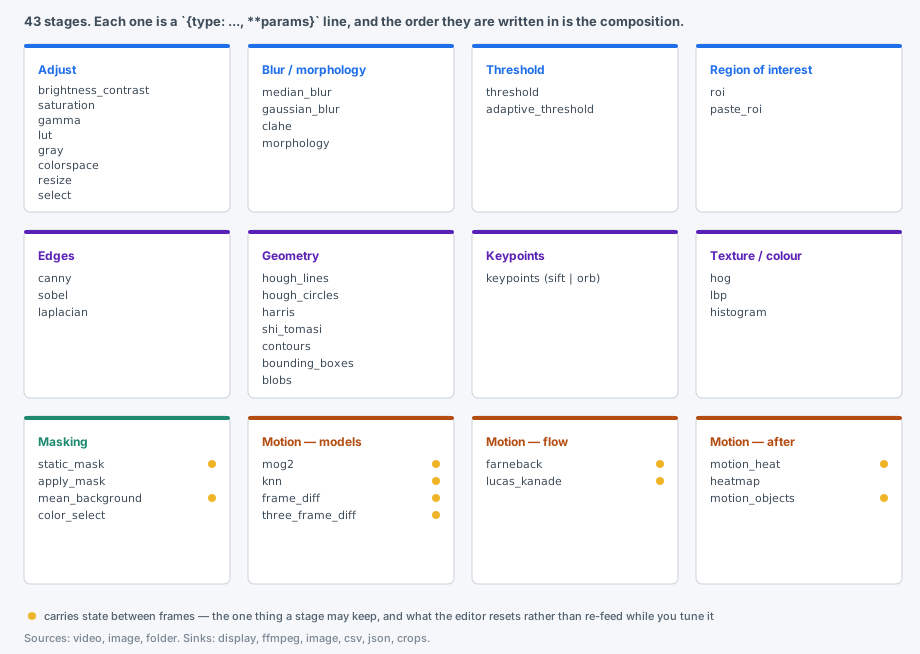
A stage marked with an amber dot carries state from one frame to the next. That is worth knowing for two reasons: it is the only thing a stage is allowed to keep, and it is what the editor has to reset rather than re-feed when you tune a paused frame.
Sources
video(path) |
frames from a video file, in order |
image(path, fps) |
a single still, as a one-frame sequence |
folder(path, pattern, fps) |
every image in a directory, sorted — a video you cannot scrub |
All three also answer count and read(index), which is what makes seeking in
the editor possible. VideoSource.read tracks its own position so playing
forward never touches CAP_PROP_POS_FRAMES — setting that forces a keyframe hunt
and a re-decode, many times slower than reading the next frame.
Stages
Adjust — brightness_contrast(brightness, contrast), saturation(gain),
gamma(value), lut(table), gray, colorspace(to), resize(size),
select(input)
Blur / morphology — median_blur(ksize), gaussian_blur(ksize, sigma),
clahe(clip_limit, tile_grid), morphology(op, ksize, iterations)
Threshold — threshold(value, mode, otsu) — modes binary, binary_inv,
trunc, tozero, tozero_inv — adaptive_threshold(method, block, c, invert)
Region of interest — roi(x, y, w, h), paste_roi(border, draw_on). The crop
runs before the operators that read it, not after: Otsu takes its level from
whatever histogram it is handed and a blur reads neighbours across the border, so
analysing the whole frame and cropping at the end lets outside pixels change
inside numbers. paste_roi puts the region back and shifts every coordinate in
ctx.rows into frame space.
Edges — canny(lo, hi), sobel(ksize, dx, dy), laplacian(ksize)
Geometry — hough_lines(...), hough_circles(...), harris(k, quality, max),
shi_tomasi(max, quality, min_dist), contours(min_area, mode, boxes, draw_on) —
modes external, list, tree — bounding_boxes(...),
blobs(min_area, max_area, circularity, convexity, dark)
Keypoints — keypoints(detector, max, sensitivity, octaves, edge, rich), where
detector is sift or orb. sensitivity is normalised 0..1 and mapped onto each
detector's own native threshold, because SIFT wants ~0.04 where ORB wants ~20 and no
config should have to know that.
Texture / colour — hog(orientations, cell, block), lbp(points, radius, method),
histogram(space, replace). HOG costs 150-300 ms on a 640x512 frame — fine for a batch,
slow enough in the editor that you will feel it.
Masking — static_mask(threshold, invert), apply_mask(input, mask, fill),
mean_background(n_frames, use_mask, buffer), color_select(space, ch0, ch1, ch2, fill)
Motion — mog2(...), knn(...), frame_diff(lag), three_frame_diff(),
farneback(pyr_scale, levels, winsize, iterations, gain),
lucas_kanade(max_points, win, gain). Every one of them emits the same thing: a
single-channel 0..255 heat image. What comes after is ordinary stages —
- {type: farneback}
- {type: threshold, value: 25, mode: binary}
- {type: morphology, op: open, ksize: 3}
- {type: motion_objects, min_area: 50}
— so a threshold means the same thing whichever algorithm is above it, and swapping
algorithms is one line. Then motion_heat(window) accumulates,
heatmap(opacity, threshold, draw_on) paints, and
motion_objects(min_area, max_travel, boxes, labels) measures.
gainon the flow stages is a calibration constant, not a derived one. At the default 32, 8 px/frame reads as full scale; a plume drifting under 1 px/frame needs it several times higher or a morphological open will erase it.examples/motion.yamluses 160 for exactly that reason.
Sinks
display(window, size, delay, quit_key) |
an OpenCV window; the quit key stops the run |
ffmpeg(path, fps, input) |
encode to mp4 through a libx264 pipe |
image(path, input) |
one file per frame — {index} in the path numbers a sequence |
csv(dir, kinds) |
one CSV per row kind, with a frame column prepended |
json(path) |
one JSON object of ctx.metrics per frame (JSON Lines) |
crops(dir, kind, input, pad) |
cut every row's rectangle out of a frame and save it |
input: on the image-producing sinks picks what they write; see
Choosing what a sink outputs.
Adding one
Register it and it exists everywhere — in configs, in the error messages, in the editor's palette, with a generated form:
@register("stage", "my_stage")
class MyStage:
    def __init__(self, radius: int = 3):
        self.radius = radius

    def apply(self, ctx: Ctx) -> None:
        ctx.image = something(ctx.image, self.radius)
Two things the rest of the system reads off that class without being told:
inspect.signature gives the parameter form, and keeping radius as an
attribute is what marks it a live knob the editor can assign while paused. A
parameter consumed at construction — handed to an OpenCV object and forgotten —
is classified as needing a rebuild, which is correct, because that is exactly
what it needs.